The Best Spaced Repetition Apps (And How to Pick One)
Your brain forgets things fast. Within 24 hours of learning something new, you lose up to 70% of it. That's not a personal failing. It's just how memory works.
Spaced repetition fixes this. It's a study method that shows you information at carefully timed intervals, right before you're about to forget it. The more you get something right, the longer the gap before you see it again. The more you struggle with it, the sooner it comes back.
The result? You retain more, study less, and actually remember what you learned weeks later.
Plenty of apps use this method. Here's a breakdown of the best ones, and what makes each worth your time.
What Is Spaced Repetition, Really?
The concept comes from a 19th-century psychologist named Hermann Ebbinghaus. He mapped out what he called the "forgetting curve," showing how quickly memory decays without review. His fix was simple: review information at growing intervals over time.
A German educator named Sebastian Leitner turned this into a physical system in the 1970s. His Leitner box method used flashcard boxes. Cards you knew well moved to a box you reviewed less often. Cards you kept missing stayed in a box you reviewed every day.
Modern spaced repetition apps do the same thing digitally. They track what you know, calculate when you're most likely to forget it, and show you that card at the right moment.
Spaced repetition works best when you pair it with active recall, the habit of pulling information from memory rather than re-reading it. Together, they're the most effective study combination that research has found.
The Best Spaced Repetition Apps Right Now
1. Anki
Anki is the gold standard for serious learners. Medical students, language learners, and bar exam takers rely on it. It uses a well-tested algorithm called SM-2 to schedule cards, and you can customize almost everything about how it works.
The downside is the learning curve. Anki feels clunky to set up, and the interface hasn't aged well. If you want power and don't mind a rough start, it's hard to beat. For a direct feature comparison, see Space Repeat vs Anki.
Best for: Heavy-duty studying, medical school, language fluency
2. Quizlet
Quizlet has a massive library of pre-made card sets, which makes it popular in schools. The basic card creation experience is polished and fast. Many users start here because their classmates are already on it and shared decks are easy to find.
The spaced repetition feature sits behind a paywall, which pushes more serious learners toward other tools. For a detailed breakdown, see Space Repeat vs Quizlet.
Best for: Students who need quick access to shared content
3. Brainscape
Brainscape uses a confidence-based rating system. After each card, you rate how well you knew it on a scale of 1 to 5. The app uses that rating to schedule your next review. It's clean and well-designed, with a solid library of pre-made decks across subjects like medical science, law, and languages.
Best for: Learners who prefer rating their confidence over pass/fail review
4. Mochi
Mochi is a newer app aimed at note-takers and learners who write a lot. It connects your notes directly to flashcards, so reviewing becomes part of your regular note-taking workflow. It supports Markdown and has a minimal, distraction-free design.
Best for: Note-heavy learners, writers, researchers
5. Space Repeat
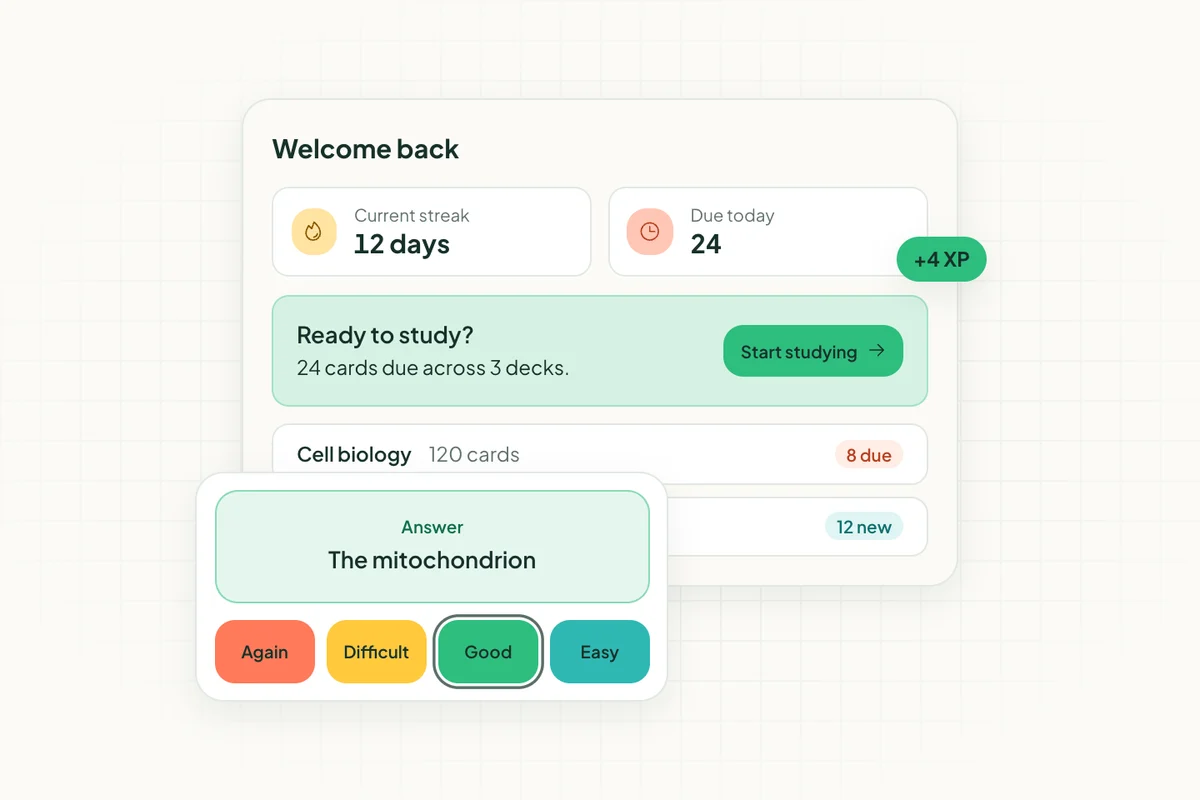
Space Repeat is built around one goal: making spaced repetition work without getting in your way. You create a deck, add your cards, and the algorithm handles the scheduling. The interface is clean, it works on any device, and you don't need a tutorial to get started.
It supports text and images, so it works as well for language learners as it does for students drilling chemistry formulas.
Best for: Anyone who wants spaced repetition without the setup headache
How the Leitner System Works (And Why Apps Replaced the Box)
The original Leitner system used physical boxes. Box 1 held cards you reviewed daily. Box 2 held cards reviewed every two days. Box 3 every four days, and so on.
When you got a card right, it moved to the next box. When you got it wrong, it went back to Box 1.
It worked well. The problem was the manual effort. Sorting cards, tracking boxes, and keeping up with multiple review schedules took real time.
A good Leitner system app automates all of this. You answer the card honestly, and the app handles the rest. That's the core of what every spaced repetition flashcard app on this list does. Space Repeat does it with the least friction.
Which App Should You Pick?
If you want raw power and don't mind a learning curve, Anki delivers. If you want something that works immediately and gets out of your way, Space Repeat is the stronger pick. If your school already uses Quizlet and you need shared decks fast, it still fills that gap.
The best spaced repetition app is the one you'll actually open every day. Pick the one that removes the most friction from that habit.
For a deeper look at the study method that makes spaced repetition effective, see Active Recall: The Most Effective Study Technique. If you want a focused breakdown of which options cost nothing at all, The Best Free Spaced Repetition App in 2026 covers that specifically.
Ready to try spaced repetition?
Space Repeat makes it easy to create flashcard decks and study with proven memory techniques. Free to start.
Start free