The Best Flashcard App for Language Learning
Learning a language is a vocabulary problem. Grammar matters, pronunciation matters, but none of it works if you don't know enough words. Most learners stall not because the grammar got too hard, but because they never built a big enough vocabulary base.
Flashcards fix this faster than almost any other method. Paired with spaced repetition, they let you build vocabulary systematically, reviewing words at the exact moment you're about to forget them. The right app makes this process feel almost automatic.
Here are the best flashcard apps for language learning right now.
What to Look for in a Language Flashcard App
Language learning has specific demands that general study apps don't always meet.
You need audio support. Seeing a word isn't the same as hearing it. A good language app lets you attach recordings or text-to-speech audio to your cards so you're training your ear alongside your memory.
You need image support. Pairing a word with a picture builds stronger memory than pairing it with a translation. Seeing a photo of a dog next to the word "perro" beats writing "perro = dog" every time.
You need spaced repetition. Vocabulary stacks up fast. Without a scheduling algorithm, you'll waste time reviewing words you already know instead of drilling the ones you keep forgetting. This is why active recall matters so much for language learning: retrieving a word from memory is far more effective than re-reading it on a list.
The Best Flashcard Apps for Language Learning
1. Anki
Anki has a strong following among serious language learners. The community has built massive shared decks for almost every language, including pre-made sets based on frequency lists so you learn the most common words first. The algorithm is excellent for long-term vocabulary retention.
Many polyglots and advanced learners credit Anki as a central part of their study routine. The setup takes time, but once your decks are running, the daily review becomes a habit.
Best for: Dedicated learners building toward fluency, especially in less common languages
2. Memrise
Memrise focuses almost entirely on language learning. It uses short video clips of native speakers pronouncing words, which gives it an advantage for listening and pronunciation practice. The spaced repetition system is solid for the content it covers.
The downside is flexibility. Memrise works best for the languages and content it already has built out. Creating fully custom decks is limited compared to Space Repeat or Anki. For a full comparison, see Space Repeat vs Memrise.
Best for: Beginners who want a guided, audio-visual experience
3. Duolingo
Duolingo is not a flashcard app, but it comes up in every language learning conversation so it's worth addressing. It uses gamification to build a daily habit, which it does well. The spaced repetition underneath is lightweight compared to dedicated flashcard tools.
For vocabulary depth and long-term retention, Duolingo alone won't take you far. Paired with a flashcard app, it works better. For a direct comparison, see Space Repeat vs Duolingo.
Best for: Building a daily habit, early-stage learners
4. Clozemaster
Clozemaster teaches vocabulary through fill-in-the-blank sentences rather than isolated cards. This gives you context around each word, which helps retention for learners who already have a foundation. It's designed for intermediate to advanced learners who want to go deeper than basic vocabulary.
Best for: Intermediate learners building contextual vocabulary
5. Space Repeat
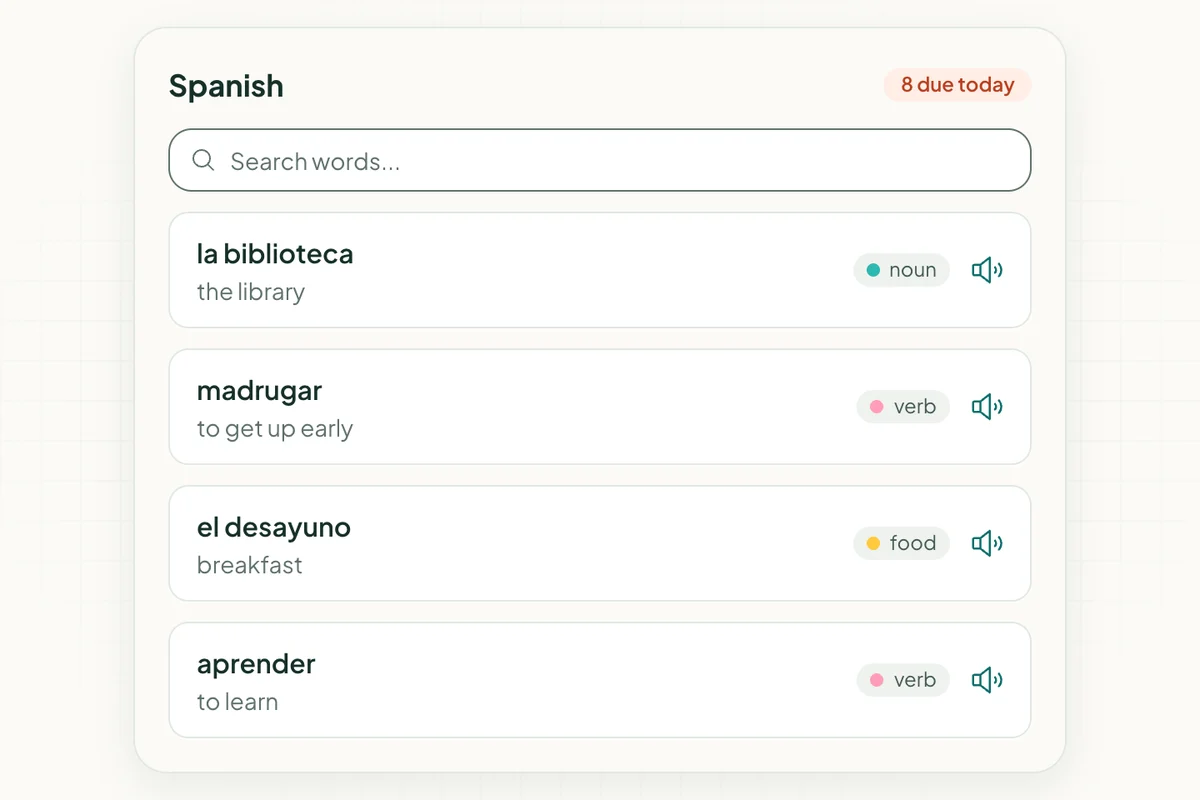
Space Repeat works well for language learning because it was built for retention, not just review. You can attach images to cards, and the spaced repetition algorithm adjusts to your performance over time.
Creating vocabulary decks is fast. You can build a deck for a specific topic, like travel phrases or food vocabulary in Italian, and study it separately from everything else. It works on any device, so you can review during a commute or a lunch break without losing your progress.
Best for: Learners who want to build their own vocabulary decks with full control over content
If you're learning a specific language, see dedicated guides: Spanish Vocabulary Flashcard App, Japanese Flashcard App, French Vocabulary Flashcard App, Mandarin Chinese Flashcard App, or Language Learning Flashcard App for a broader overview.
How Many Words Do You Actually Need?
For basic conversation in most languages, 1,000 to 2,000 words gets you a long way. For reading newspapers and following native speech, you're looking at 5,000 to 10,000 words.
With spaced repetition and about 20 minutes of daily review, most learners can add 10 to 20 new words per day and retain them long-term. At that pace, 1,000 words takes less than two months.
The bottleneck isn't time. It's consistency. Pick an app you'll actually open every day.
How to Build Your First Language Deck
Start with frequency lists. These rank vocabulary by how often words appear in real speech and writing. Learning the top 500 most common words in your target language first gives you a foundation that makes everything else easier to understand.
From there, build topic-specific decks: food, directions, numbers, work vocabulary. Keep each deck focused. Mixing 500 random words into one deck makes it harder to track progress.
Space Repeat lets you build and organize decks by topic, so you can work through high-frequency vocabulary in one deck and conversation phrases in another, reviewing each on its own schedule.
The Best Pick for Language Learners
If you want a flashcard app built for language learning that gives you full control over your content, Space Repeat is the strongest pick. Anki is close, but the setup time and the iOS cost push some learners toward something simpler.
Anki supports audio and images. Space Repeat supports images. Both use real spaced repetition. The main difference is how long it takes to get started and how much friction you're willing to accept.
For a primer on the study technique that makes flashcard review effective regardless of which app you use, Active Recall: The Most Effective Study Technique is worth reading alongside this guide.
Ready to try spaced repetition?
Space Repeat makes it easy to create flashcard decks and study with proven memory techniques. Free to start.
Start free