Why Space Repeat Doesn't Use AI to Generate Your Flashcards
A lot of flashcard and note-taking apps now advertise the same feature: upload a PDF, snap a photo of your notes, or paste in a chunk of text, and AI will read it and generate flashcards for you. It's marketed as a time-saver, and on the surface it looks like one. Fewer clicks, an instant deck, back to studying.
Space Repeat doesn't have this feature, and that's not an oversight. It's a deliberate choice, and it's one of the clearest differences between this app and most of the others.
The Problem With Letting AI Build Your Flashcards
Here's what actually happens when a student uploads a chapter and lets AI turn it into cards: they never fully read the chapter. They skimmed it, uploaded it, and let something else decide what mattered. The flashcards get made, the deck fills up, and the student starts reviewing material they never really engaged with in the first place.
That's a problem, because deciding what belongs on a flashcard is not a mechanical step you can outsource. It's a big part of the learning itself. To turn a page of notes into a good question, you have to know what the core idea is, what's just supporting detail, and what's likely to matter later. That's the same thinking you need for the exam. If AI does that thinking for you, you've skipped the part where you actually learn the material, and replaced it with a deck of cards you didn't create and don't fully understand.
AI Doesn't Know What's on Your Exam
There's also a more practical issue. An AI model reading your notes has no idea what your professor actually cares about. It doesn't know that your professor spent twenty minutes on one obscure diagram because it always shows up on the final. It doesn't know your professor said to skip an entire section because it won't be tested this year. It doesn't know which of the fifteen dates in a history chapter your class discussion actually focused on.
A generic model can only work from what's in the document. It can't tell important from unimportant the way you can, because you were in the room. You have context no upload ever will.
Making the Card Is Itself a Study Technique
This connects to something already well established about how memory works: active recall is one of the most effective ways to learn, and it works because retrieving and reformulating information is harder, and more useful, than just reading it. Writing your own flashcard question is a form of that same work. You're taking an idea, deciding how to phrase it as a question, and figuring out what a complete answer looks like. That's closer to the Feynman Technique than it is to data entry: if you can't turn a concept into a clear question and answer, you've usually found a gap in your own understanding, and that's worth knowing before the exam, not during it.
This isn't just a hunch. It's one of the more robust findings in memory research, known as the generation effect: people consistently remember material better when they produce it themselves rather than simply being given it to read. In the study that first mapped this out in detail, Slamecka and Graf (1978) ran five separate experiments comparing words participants generated themselves against the same words when participants just read them, and the generated words won on every single memory measure they tested. A flashcard you wrote is, in effect, a small act of generation. A flashcard an AI extracted for you is the "read" condition wearing a flashcard's clothing.
The same pattern shows up at the level of whole study strategies. Karpicke and Blunt (2011), published in the journal Science, found that students who practiced retrieving material from memory learned more, including on questions requiring inference, not just recall, than students who spent the same amount of time on elaborative study techniques like concept mapping. Building your own flashcards is retrieval practice from the very first step. Uploading a file for AI to process is not.
This isn't just an older finding that happens to apply. A 2025 MIT Media Lab study, Your Brain on ChatGPT, looked at this exact failure mode with AI specifically. Using EEG, researchers found that participants who wrote essays with an AI assistant's help showed the weakest brain connectivity of any group tested, reported the lowest sense of ownership over what they had supposedly written, and struggled to quote their own essay back just minutes after finishing it. When the work passes through the AI instead of through you, very little of it sticks, whether that work is an essay or a flashcard deck. (Worth flagging: this is a preprint that hadn't completed peer review at the time of writing, but it points the same direction as decades of generation-effect research above.)
Handing that step to AI doesn't just save you time. It removes the part of the process where the actual learning was happening.
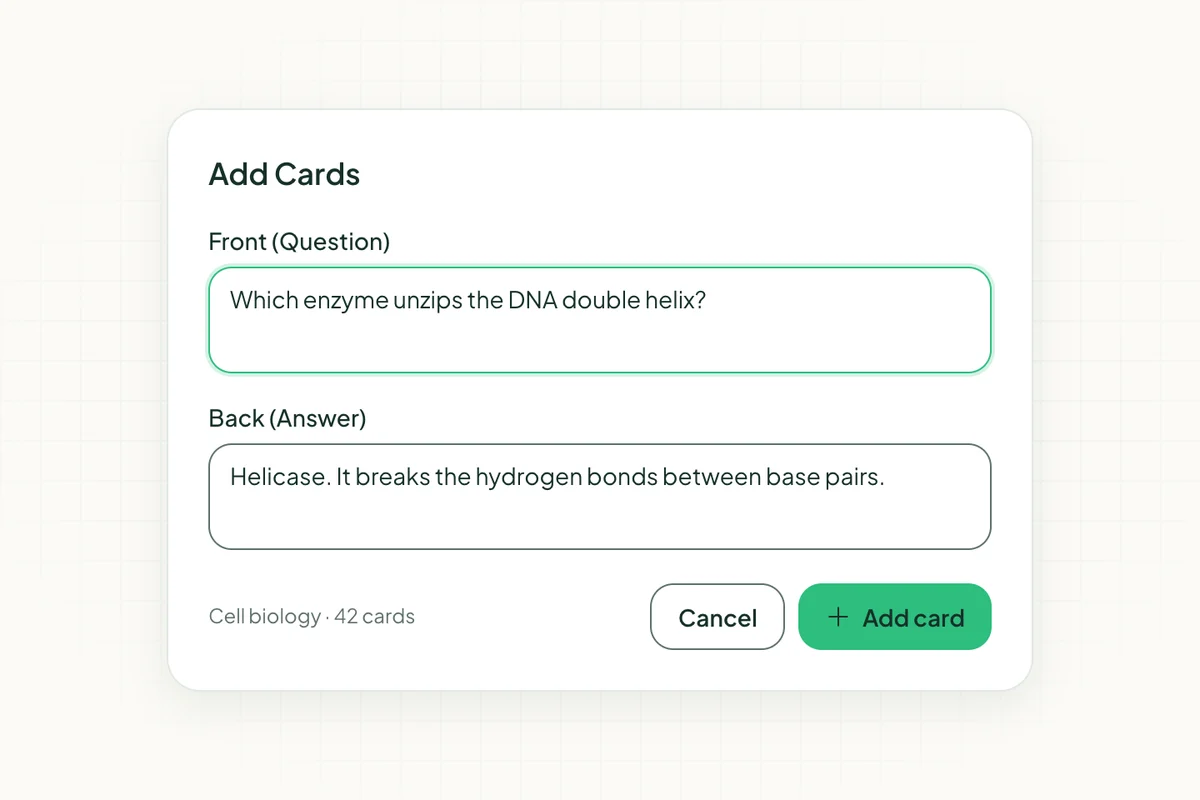
Ready to build your own deck?
Space Repeat makes it easy to create flashcards and study with proven memory techniques. Free to start.
Try Space RepeatAI Isn't Useless, It's Just Not a Substitute
None of this means AI has no place in studying. Asking an AI model to explain a confusing concept in simpler terms, quiz you conversationally, or suggest how to organize a set of topics you've already learned is a reasonable use of it. Those uses help you understand the material better before you sit down to make cards.
What doesn't work is asking AI to read the material on your behalf and decide what's worth remembering. That's not a shortcut to studying. It's a way of skipping it while still ending up with something that looks like a completed deck.
If you want to use AI as part of your process, the better order is: read the material yourself, use your own ChatGPT account (or whichever tool you prefer) to clear up anything confusing, and then come back and build the cards yourself once you actually understand what you're studying. At that point, the flashcards you make will be better than anything an upload could have produced, because they'll reflect what you personally found difficult, not what a model guessed was important.
Why This Also Keeps Space Repeat Simple
There's a practical side to this decision too. Running AI models to process documents at scale is expensive, and that cost has to come from somewhere: a subscription, a usage cap, or a "free" plan so limited it barely qualifies. Not building this feature keeps Space Repeat's running costs low. That's part of why it can be free during the beta, and why, if pricing arrives later, it can stay simple instead of being built around usage caps or AI credits.
Space Repeat is built around one idea: you understand the material, you decide what matters, you build the deck, and the app takes care of scheduling your reviews so you don't forget it. That division of labor isn't a limitation. It's the reason the studying actually works.
Ready to try spaced repetition?
Space Repeat makes it easy to create flashcard decks and study with proven memory techniques. Free to start.
Start free