The Best Free Spaced Repetition App in 2026
Spaced repetition is one of the most effective study methods ever tested. Decades of memory research back it up. The core idea is simple: review information at increasing intervals, right before you forget it, and your brain moves it into long-term memory far more reliably than cramming ever could.
The problem is that a lot of apps use "spaced repetition" as a marketing term while locking the actual algorithm behind a subscription. You sign up, build your decks, and then discover that the scheduling feature costs $8 a month.
This guide cuts through that. Here are the best spaced repetition apps that are genuinely free, with a clear breakdown of what each one actually gives you at no cost.
What Makes a Spaced Repetition App Worth Using
Before the list, it's worth being specific about what the term "spaced repetition" means in practice. It works best when combined with active recall, the practice of pulling information from memory rather than re-reading it. Together they're the strongest study combination research has found. A real spaced repetition system does three things.
First, it tracks your performance on each card individually. Getting a card right twice in a row means something different from getting it right once after failing it five times.
Second, it schedules your next review based on that performance. Cards you know well come back less often. Cards you keep missing come back soon.
Third, it adjusts over time. The longer you use the system, the more accurately it predicts when you need to see each card again.
Apps that just shuffle your cards randomly or let you flip through them in order are not doing spaced repetition. They're doing random review with a different name.
The Best Free Spaced Repetition Apps
1. Space Repeat
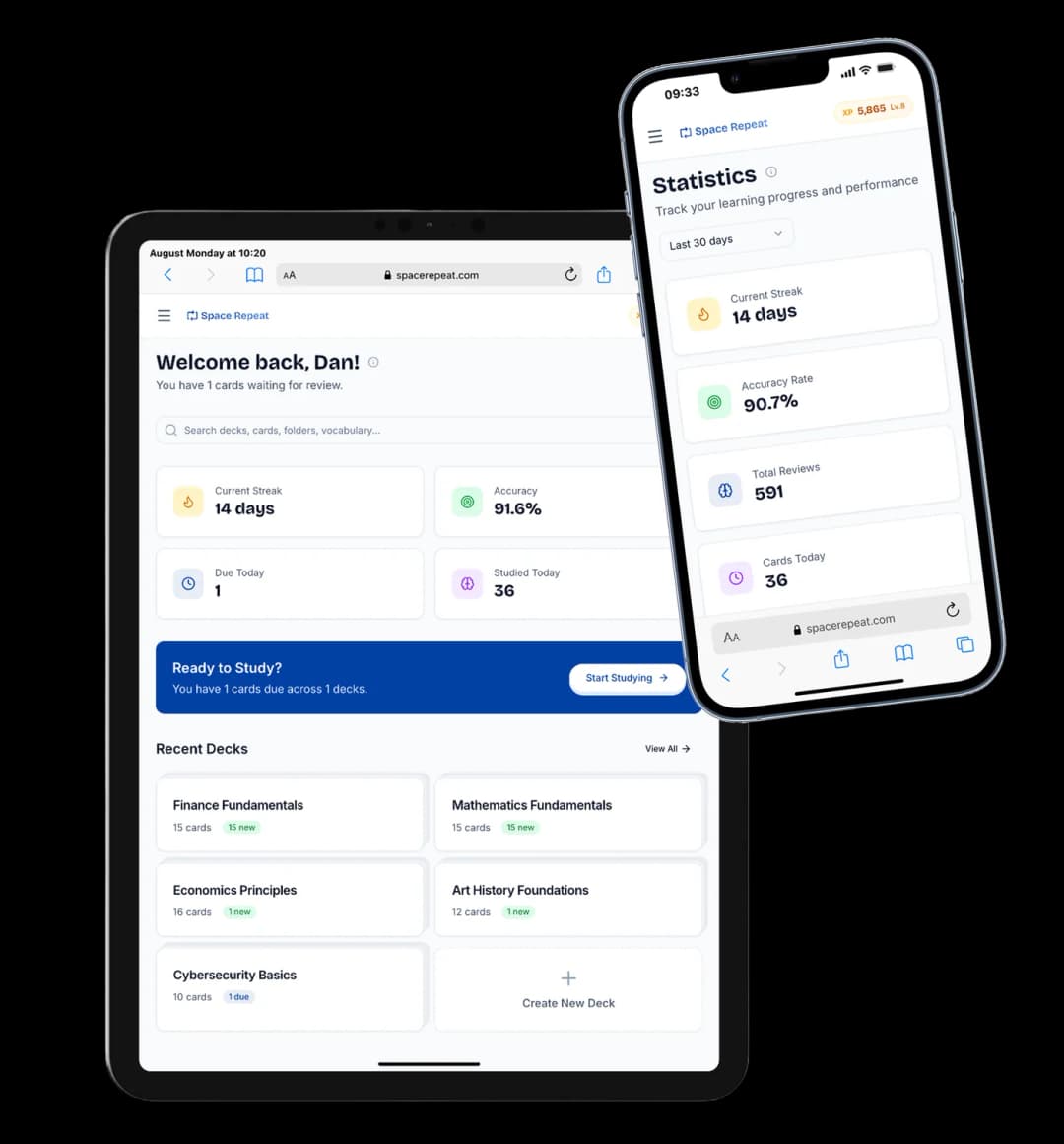
Space Repeat is a free spaced repetition app built around retention from the start. The full scheduling system is available without a subscription. You create a deck, add your cards, and the algorithm tracks your performance automatically.
After each card, you rate how well you knew it. The app uses that rating to calculate when to show you the card again. Get it right consistently and the interval stretches out. Struggle with it and it comes back sooner.
The free plan is generous rather than unlimited: currently up to 50 decks and 100 cards per deck, with no feature gates on the scheduling itself. Those caps are expected to grow over time as the app develops. The app works on any device through your browser, so your review schedule carries over whether you're on your phone or your laptop.
Cost: Completely free. No paid tier, no subscription. Full spaced repetition, image support, and a generous free plan (up to 50 decks, 100 cards each) that's set to expand.
2. Anki
Anki is the most powerful free spaced repetition tool available. It uses the SM-2 algorithm, one of the most studied scheduling systems in existence, and gives you deep control over how it works. The community has built thousands of shared decks across subjects ranging from medical school anatomy to Japanese kanji.
The trade-off is the interface. Anki feels dated and takes real time to set up. New users often spend an hour figuring out settings before they review their first card. Once it's running, the algorithm is excellent. Getting there is the hard part.
Anki is free on Windows, Mac, Android, and Linux. The iOS app costs $25, which is a meaningful exception if you study primarily on an iPhone.
What's free: Full algorithm and all features, on all platforms except iOS.
3. Mochi
Mochi has a free tier that includes spaced repetition scheduling. It's designed for learners who already take notes and want to turn those notes into flashcards without switching tools. The interface is minimal and supports Markdown, which makes it a natural fit for people who write a lot.
The free plan has a deck limit, which is worth checking before you build out a large study system.
What's free: Spaced repetition on a limited number of decks.
4. RemNote
RemNote integrates notes and flashcards in one tool. As you write, you can tag specific facts to automatically become flashcard prompts. The spaced repetition runs on the same content, so reviewing and note-taking happen in the same place.
The free tier includes the core spaced repetition features, though some advanced options sit behind a paid plan.
What's free: Core note-taking with spaced repetition on your own content.
What to Avoid: Apps That Paywall Their Algorithm
Several popular apps advertise spaced repetition but charge for it. Quizlet's spaced repetition mode requires Quizlet Plus. Brainscape's full scheduling system has limits on its free tier. This isn't necessarily a reason to avoid them, but it's worth knowing before you spend time building decks.
If you want spaced repetition from day one without hitting a paywall, Space Repeat and Anki are the two strongest options. Space Repeat is simpler to start. Anki gives you more control once you're comfortable.
How to Get the Most From a Free Spaced Repetition App
The algorithm is only as good as the cards you feed it. A few habits make the system work much better.
Keep each card focused on a single fact. Cards that ask multiple things at once are hard to rate honestly, which throws off the scheduling.
Rate your cards honestly. If you got the answer but it took you ten seconds of staring, that's not a confident recall. Rating it as hard rather than easy means the card comes back sooner, which is the right call.
Review consistently. Spaced repetition works over time. A daily ten-minute session outperforms a two-hour session once a week. The algorithm assumes you're showing up regularly. Gaps in your review schedule push cards past their ideal review window.
The Bottom Line
If you want a free spaced repetition app that works immediately and doesn't charge for the feature that makes it valuable, Space Repeat is the clearest option. Anki is the alternative if you want deeper algorithmic control and don't mind the setup cost.
Either way, the key feature is real scheduling. An app that shuffles cards randomly isn't doing spaced repetition. The ones on this list are.
For the study technique that pairs best with spaced repetition, see Active Recall: The Most Effective Study Technique. For a broader comparison of the top tools, The Best Spaced Repetition Apps covers the full landscape.
Ready to try spaced repetition?
Space Repeat makes it easy to create flashcard decks and study with proven memory techniques. Free to start.
Start Free